
Industrial-Grade Animal Fat Primary Rendering
Explore MoreFood-Grade Animal Fat Primary Rendering
Explore MoreRendering animal fat is the thermal process of separating usable fat from raw animal tissue — such as fatty trim, bones, and slaughter by-products — by applying controlled heat to break down cell membranes and release stored lipids. The resulting products are commonly called tallow (rendered from beef or mutton), lard (rendered from pork), or poultry fat, and are used across food manufacturing, animal feed, oleochemicals, and biofuels. At an industrial scale, rendering animal fat runs in either batch systems, which offer process flexibility for medium-scale operations, or continuous lines, which deliver high-throughput, automated production with consistent fat quality — each with distinct equipment requirements, capital costs, and yield profiles covered in this guide.
The animal fat rendering process converts high-fat raw materials into crude animal fat (tallow) for downstream refining and industrial use. Modern rendering systems emphasize yield, process stability, and consistent product quality. With proper equipment and control, plants produce crude fat with low free fatty acids (FFA) and minimal impurities, meeting specifications required for further refining.
Animal fat rendering is the controlled process of extracting purified fat from raw animal tissue — primarily fatty trimmings, back fat, and organ fat — through the application of heat, pressure, and mechanical separation. Heat breaks down the cell structure of adipose tissue, releasing lipids that are then clarified, separated from water and solids, and recovered as usable crude fat.
The main end products of a rendering operation include:
Rendering operates at two fundamentally different scales. At the home or artisan level, rendering involves slowly melting fat on a stovetop or in an oven until it liquefies and solid connective tissue separates. At the industrial level, purpose-built rendering lines — equipped with cooking kettles, screw presses, centrifuges, and heat recovery systems — process hundreds to thousands of tonnes of raw material per week under tightly controlled temperature, pressure, and moisture conditions.
This guide covers industrial animal fat rendering: the core process steps, the equipment involved, and how to choose between batch and continuous rendering systems based on plant capacity and operational requirements.
The Animal Fat Rendering Process uses primarily fatty tissue and trimmed fat as raw materials. Rendering lines are classified as batch or continuous, each tailored to production scale, throughput, and energy efficiency.
The objective is to maximize crude fat recovery while minimizing solids in the liquid phase, setting up the material for downstream refining.
The downstream application determines the quality specifications — particularly FFA content, moisture, and color — that the rendering process must achieve. Rendered animal fat serves four primary industrial markets:
Tallow and lard remain widely used in commercial frying, pastry production, and processed food manufacturing due to their thermal stability and extended shelf life compared to vegetable oils.
Animal tallow is a major feedstock for soap, fatty acid, glycerin, and biodiesel production. Oleochemical processors require crude fat with tightly controlled FFA levels and minimal impurities, making process control at the rendering stage commercially critical.
Rendered poultry and ruminant fats are incorporated into feed formulations as concentrated energy sources. Feed-grade rendering requires consistent MIU (moisture, impurities, and unsaponifiables) levels and strict hygiene standards at every stage.
Lower-grade rendered fat is used as a lubricant base, in leather processing, and as a release agent in industrial manufacturing operations.
Understanding the target application before selecting rendering equipment and process parameters ensures that plant output consistently meets customer specifications.
High-fat raw materials are cleaned and cut into uniform sizes to promote even heating and efficient fat separation. Maintaining hygiene during preparation is critical for food safety and consistent quality.
Fat melting kettles operate under negative pressure (−0.02 to −0.08 MPa), which accelerates water evaporation at lower temperatures while protecting thermolabile fatty acids and limiting oxidation. Batch cookers typically run at 85–105°C for cycle times of 3–6 hours per batch. Continuous systems operate at 110–130°C with active residence times of 10–30 minutes. At the end of this stage, a well-operated system recovers 75–85% of total available fat as free liquid oil, minimizing the load on downstream pressing.
Presses extract remaining oil from solids discharged by the cooker. Screw presses — standard on continuous lines — operate at 15–30 RPM with adjustable back pressure, targeting a cake moisture content below 15%. Hydraulic presses suit batch operations where maximum fat extraction per cycle is prioritized. This stage recovers an additional 8–12% of fat, bringing total crude fat recovery to 83–92% of theoretical yield.
Centrifuges operating at 4,000–6,000 RPM remove suspended solids, residual moisture, and fine impurities to produce stable crude animal fat ready for storage or downstream refining. Accepted specifications for crude animal fat at this stage:
Rendered fats are stored under controlled temperature and light conditions to prevent oxidation. Key quality parameters monitored include:
Strict adherence to these parameters ensures fats are suitable for food-grade applications and maintain long shelf life.
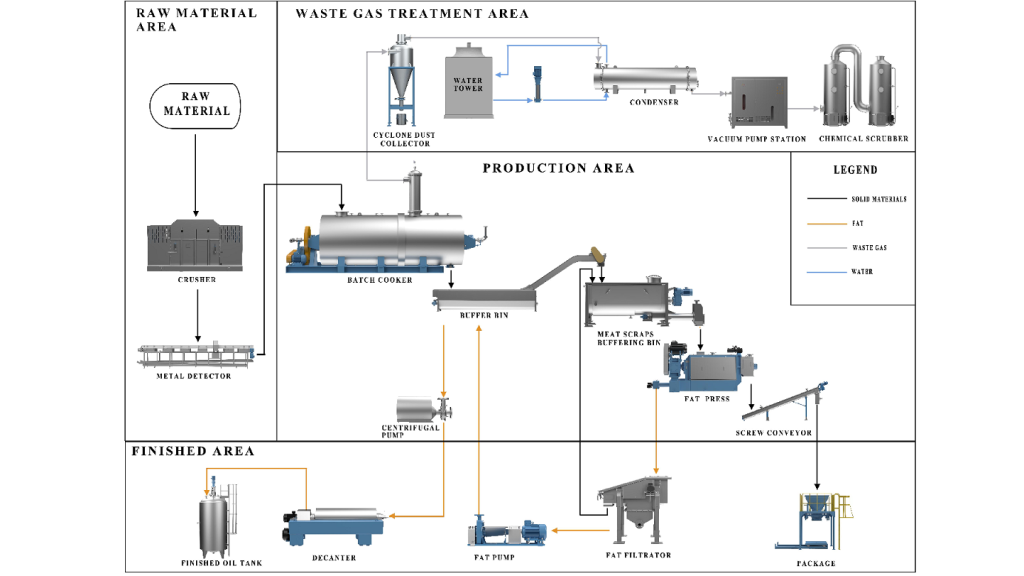
The table below summarizes standard operating benchmarks for both rendering system types as a practical reference for plant engineers and procurement teams.
| Parameter | Batch System | Continuous System |
|---|---|---|
| Operating temperature | 85–105°C | 110–130°C |
| Operating pressure | −0.02 to −0.08 MPa | −0.02 to −0.06 MPa |
| Cycle / residence time | 3–6 hours per batch | 10–30 minutes |
| Crude fat recovery at cooker | 75–85% | 78–87% |
| Total recovery after pressing | 83–90% | 86–92% |
| Final FFA (food-grade target) | ≤ 1.5% | ≤ 1.5% |
| Final MIU target | ≤ 1.0% | ≤ 1.0% |
| Feature | Batch Line | Continuous Line |
|---|---|---|
| Throughput | Moderate | High (large-scale plants) |
| Process Control | Flexible | Automated, consistent quality |
| Fat Yield | High | High and uniform |
| Capital Investment | Lower | Higher |
| Recommended Use | Medium-scale crude rendering | Large-scale crude rendering |
The Animal Fat Rendering Process provides an efficient and reliable method for converting high-fat raw materials into crude animal fat ready for refining. By controlling temperature, pressure, and separation parameters, the process achieves high recovery rates while maintaining stability and minimizing oxidation.
Modern rendering operations emphasize automation, energy efficiency, and environmental compliance. Through optimized heat utilization and closed-system operation, producers ensure consistent output quality, reduced emissions, and sustainable performance across the entire rendering line.
 Industry Success Case
 Industry Success Case
 Industry Success Case
 Industry Success Case

Chinese (Simplified)

English

Russian