
Industrial-Grade Animal Fat Primary Rendering
Explore MoreFood-Grade Animal Fat Primary Rendering
Explore MoreCentrifuge separation improves oil purity and recovery rate by using high-speed rotational force to split rendered fat into distinct phases — clean oil, water, and fine solids — far more precisely than settling or filtration alone. This extra separation step removes residual moisture and protein fines that would otherwise darken the oil, shorten its shelf life, or push free fatty acid levels upward. For plants targeting edible-grade tallow, biodiesel feedstock, or oleochemical inputs, the centrifuge stage is often the single biggest lever for lifting both yield and grade at the same time.
Batch and continuous rendering lines both produce a raw fat output that still contains suspended water droplets, protein particles, and small amounts of bone or tissue fines. Gravity settling tanks can separate some of this over time, but they're slow, space-intensive, and leave behind a layer of emulsified material at the oil-water interface that never fully clears.
An oil-residue separator handles the bulk of this work after cooking and pressing, pulling out the larger solid fraction. But the finer impurities — the ones that actually affect color, odor stability, and storage life — require centrifugal force to separate cleanly. This is the gap centrifuge separation is built to close.
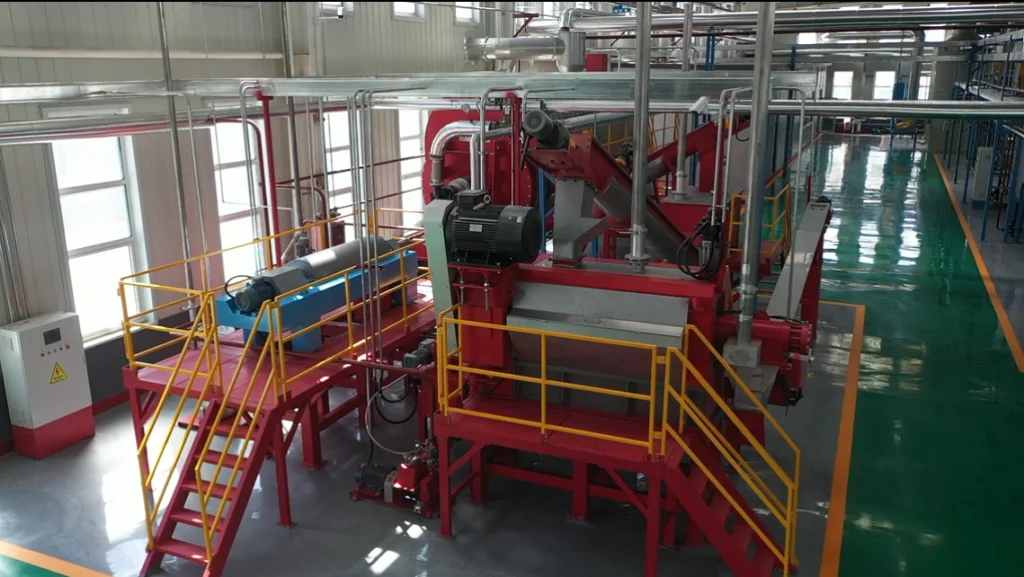
A disc centrifuge spins the incoming fat mixture at high speed, generating centrifugal force many times stronger than gravity. Because oil, water, and solid particles have different densities, this force pushes the heavier water and fines outward toward the bowl wall while the lighter, purified oil migrates toward the center outlet.
This continuous, high-throughput separation is one reason centrifuges are standard equipment on continuous animal fat rendering lines, where the process cannot pause for slow settling stages.
Oil purity and recovery rate are often discussed as separate goals, but in practice they move together. Every fraction of moisture or fine solid left in the fat is a fraction of usable oil volume lost, either as trapped emulsion or as material discarded with the sludge phase. A centrifuge that separates phases cleanly recovers more of the oil that would otherwise be locked in that interface layer.
This is why plants that upgrade from basic settling to centrifuge separation typically see improvement in both metrics at once — not a trade-off between them. The clarified oil also holds up better in storage, since residual moisture is a primary driver of hydrolytic rancidity and free fatty acid increase over time, a concern covered in more depth in our post on tallow quality standards — though for now, the key point is that clean separation protects shelf value, not just immediate yield.
Centrifuge separation is a polishing stage, not a replacement for upstream equipment. In a typical continuous line, material moves from the disc dryer or fat melting kettle into an oil-residue separator, then into the centrifuge for final clarification before storage or refining. Skipping stages upstream — for example, feeding poorly cooked material directly to a centrifuge — overloads the unit and reduces its separation efficiency.
Readers comparing core rendering equipment options may find our breakdown in Disc Dryer vs. Fat Melting Kettle useful for understanding what feeds into this separation stage.
A mid-sized beef tallow processor once ran into recurring buyer complaints about cloudy oil and inconsistent color between batches, despite no changes to raw material sourcing. Investigation traced the issue to an aging centrifuge running below its rated separation efficiency — the bowl had accumulated scale buildup that reduced disc stack performance, allowing more fine solids to pass through with the oil phase.
After servicing the unit and adjusting feed temperature into the centrifuge, both clarity and consistency improved within the first production run. This kind of scenario is common: purity problems often get blamed on raw material quality first, when the actual cause is a separation stage quietly underperforming. It's a pattern we've also seen documented in our beef processing plant case study on premium edible tallow recovery.
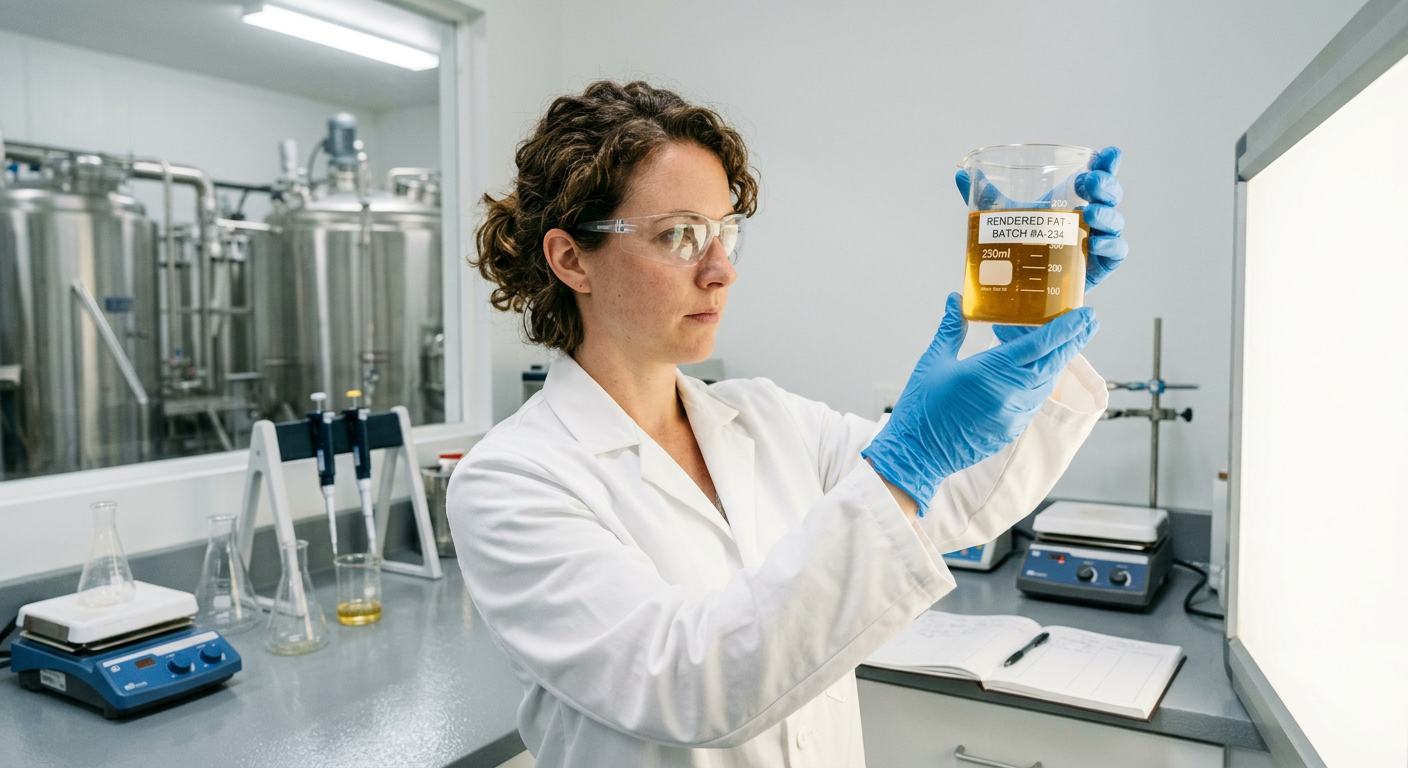
Centrifuge separation efficiency is sensitive to the viscosity of the incoming fat, which is why feed temperature control matters more than operators often expect. Fat that's too cool separates poorly because it's too viscous for the phases to migrate efficiently under centrifugal force; fat that's too hot can destabilize the process or increase oxidation risk. Maintaining a consistent, controlled feed temperature — rather than letting it drift with upstream process variation — is one of the simplest ways to stabilize centrifuge output without any equipment changes.
Plants running mixed raw material batches, where fat composition and melting behavior vary day to day, often benefit from a small buffer tank ahead of the centrifuge to even out temperature swings before separation.
Usually linked to insufficient dwell time in the bowl, incorrect disc stack configuration for the fat type being processed, or feed rates exceeding the unit's rated capacity.
Often caused by density interface settings that are miscalibrated for the specific fat being processed — animal fats vary enough in density that settings tuned for one raw material batch may need adjustment for another.
Typically traced back to inadequate pre-treatment upstream, meaning the oil-residue separator or dryer stage isn't removing enough coarse solids before the material reaches the centrifuge.
Most of these issues are process-tuning problems rather than equipment failures, which is why regular monitoring of separation output — not just periodic maintenance — is part of stable centrifuge operation.
Undersized centrifuge capacity relative to overall plant throughput is one of the more common design mistakes we see when reviewing existing rendering lines. If the centrifuge becomes the bottleneck, operators are sometimes tempted to push feed rates beyond the unit's design capacity just to keep the line moving — which directly sacrifices separation quality for throughput.
This is one reason plant layout and equipment sizing decisions should be made together rather than sequentially, a point we cover in more detail in how to design the layout of an animal fat rendering plant. For clients scaling up production, this is also a case where our rendering solutions team typically reviews the full material flow, not just the centrifuge spec sheet, before recommending a unit.
 Industry Success Case
 News
News
 Industry Success Case
News
News
Industry Success Case
News
News
 News
News

Chinese (Simplified)

English

Russian