
Industrial-Grade Animal Fat Primary Rendering
Explore MoreFood-Grade Animal Fat Primary Rendering
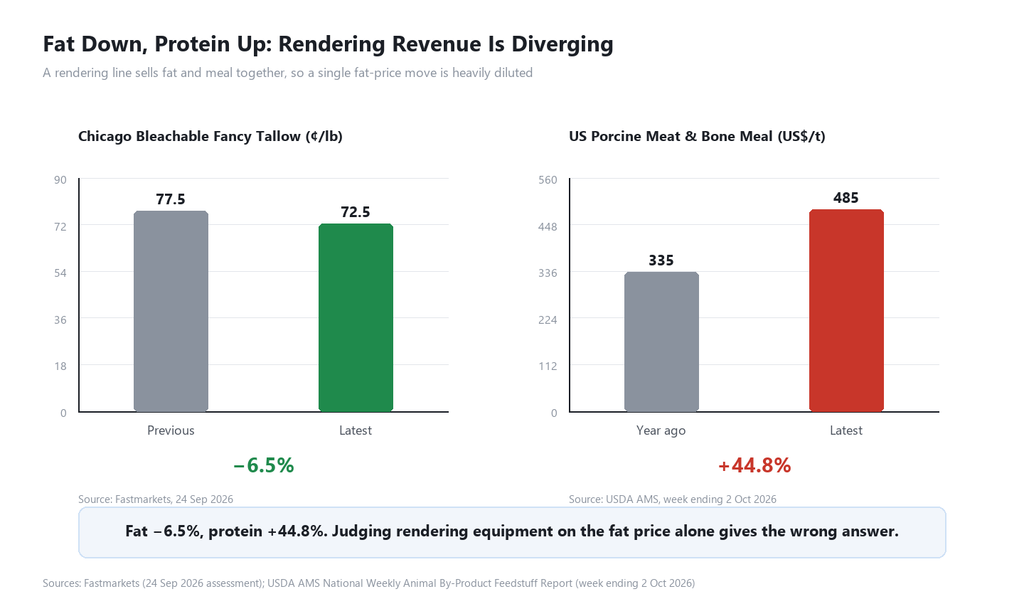
Explore MoreYes, there is still profit — but it does not come from betting on the fat price. In October 2026 the market is split: fat is falling while protein is climbing. Chicago bleachable fancy tallow (BFT) sits at 72–73 ¢/lb, down from 77.50. US porcine meat & bone meal (MBM) is quoted at $420–550/t, against $335 a year ago. For slaughterhouses and rendering/collection operators the raw material is waste that must be disposed of anyway — and they are often paid to take it — so the fat sale is pure incremental revenue. Whether animal fat rendering equipment pays for itself is decided by fat yield, energy consumption and raw-material cost, not by today's oil price.
Four price anchors are usable this period:
As a secondary reference, industrial-grade mixed oil in East China was quoted at ¥7,450–8,050/t (≈$1,110–1,200/t) in late September 2026.
What matters is not how far fat has fallen. It is that a rendering line is paid twice — once for fat, once for protein meal. When fat softens and protein strengthens, total revenue swings far less than the fat price alone. Judging a rendering investment on the fat price by itself is the most common mistake in this business.
For these operators the raw material is not "bought" — it is material that must be disposed of under animal by-product rules. In the EU, Regulation (EC) No 1069/2009 sorts by-products into Category 1, 2 and 3 and requires safe processing for each. Because disposal is mandatory, the renderer is normally paid a collection or processing fee to take the material, which makes the raw material free — or effectively negative-cost.
In China the same logic appears as explicit subsidies. Under a September 2026 public notice from Xiangshan County, Ningbo, the schedule ran to ¥800 per diseased hog in lost value, ¥160 per head for safe disposal and ¥0.8 per kg for resource recovery (Xiangshan County Government); slaughter-stage disposal fees of roughly ¥80 per head are common elsewhere.
When the raw material costs nothing — or less than nothing — a fall in fat value from ¥8,000/t to ¥6,000/t cuts profit; it does not create a loss. A rendering line's real job is converting a disposal cost into product revenue.

When raw material is bought at market price, raw material and finished goods move in the same direction. China's hog price in October 2026, for example, was ¥10.28/kg, down 18.54% year on year. On the vendor's stated figures, a combined fat-plus-meal yield of 55–58% (fat roughly 47.5%) leaves a net margin of about ¥465–735 per tonne of input — thin, highly sensitive to yield, and in need of three to six months of working capital.
Expecting the press or the centrifuge to rescue your oil yield is a directional error. Fat yield and the residual oil left in the press cake are fixed the moment cooking finishes; pressing, drying and centrifuging can only recover fat that has already been released — they cannot repair an upstream deviation. Three things decide the outcome:
Historically animal fat had three outlets — food, feed and soap-making. In 2026 biofuel has been added as a fourth, with a stronger financial character: biodiesel and sustainable aviation fuel (SAF) feedstock. Used fats and oils now have a price floor, and the parties bidding for them have widened from feed mills to energy companies. That changes the bargaining position of anyone who can supply consistent, low-free-fatty-acid material.
Vendor payback estimates of one to two years share a common flaw: they assume full capacity, a fixed raw-material price and a fixed product price, and they ignore downtime and seasonality. A credible calculation re-runs the same model at 60–70% load and tests three scenarios — raw-material seasonality, winter curtailment and a fall in finished-fat value. For scale, a 5–10 t/day line runs to roughly $22,000–60,000 (¥150,000–400,000), 10–30 t/day to about $120,000–300,000, and above 30 t/day it exceeds $300,000.
Q: If fat prices are falling, is buying rendering equipment a way to "buy the dip"?
Not the same thing. Equipment is a capacity investment; fat is a commodity price. The genuine benefit of a low fat price is that raw material is easier and cheaper to source — and if your raw material already comes from your own slaughter or collection operation, that benefit does not apply to you. The payback period depends on your raw-material structure, not on the price of the machine, so work backwards from a conservative annual profit instead.
Animal fat price volatility is not, by itself, the answer to whether you should buy animal fat rendering equipment. The fat price sets how thick the margin is; the raw-material structure decides whether there is a margin at all. In 2026's "weak fat, strong protein, new biofuel outlet" configuration, the economics of building a rendering line are actually improving for slaughterhouses and collection operators that own the disposal rights and the feedstock — while processors who buy material in should put their decision weight on yield, energy and working capital.
 Industry Success Case
 News
News
 Industry Success Case
 Uncategorized
News
News
Uncategorized
News
News

Chinese (Simplified)

English

Russian